
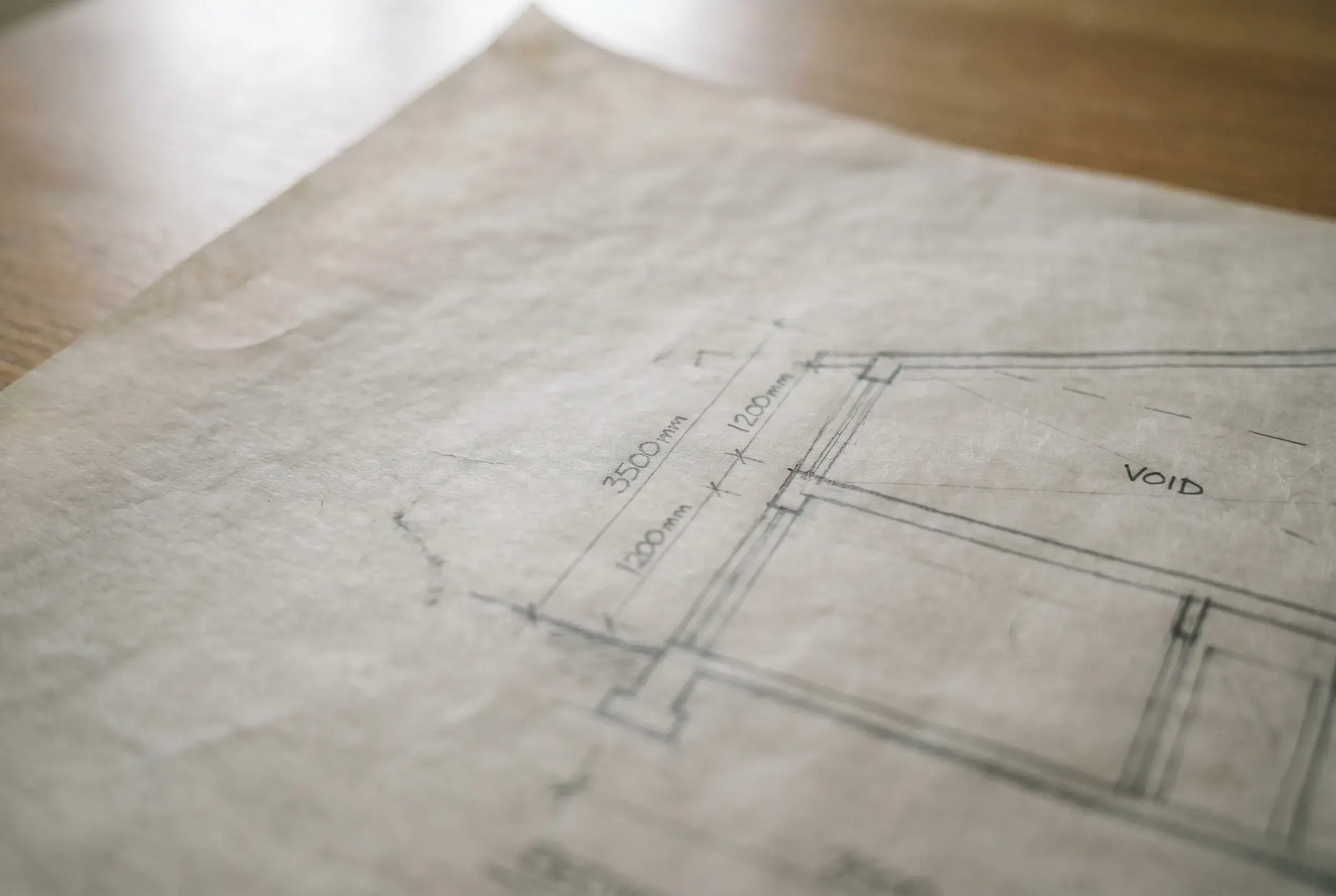
Every project we work on starts the same way. Phil at the studio table with a roll of tracing paper, an HB pencil, and a scale rule. The first month of drawings is mostly that.
The argument for hand drawing is not nostalgia. It is about resolution. A pencil line can be any thickness; a wall on a CAD plan is exactly the thickness the wall layer says it is. The pencil records uncertainty. The CAD plan pretends there is none.
So when a wall is provisional — when we are still asking whether it is a wall or a curtain or a step in the floor — the pencil draws it light, and the next plan draws it darker, and by the seventh sketch it has the weight of a real wall and the project moves on. None of those intermediate drawings can be made in a programme that requires you to commit.
“CAD is for making the building. Pencil is for finding it.”
We move to CAD around the planning stage. Once the plan has been drawn forty or fifty times and the section nine times, there is something there to draw cleanly. Before that, the hand is faster and more honest. The drawings stack up in a flat file in the studio, dated, scribbled on, an obvious record of where the design came from.
The client gets the pencil drawings as much as the CAD ones. We find clients understand them better. A pencil line is a thinking line; it is easier to disagree with than a CAD line, which always looks decided.