
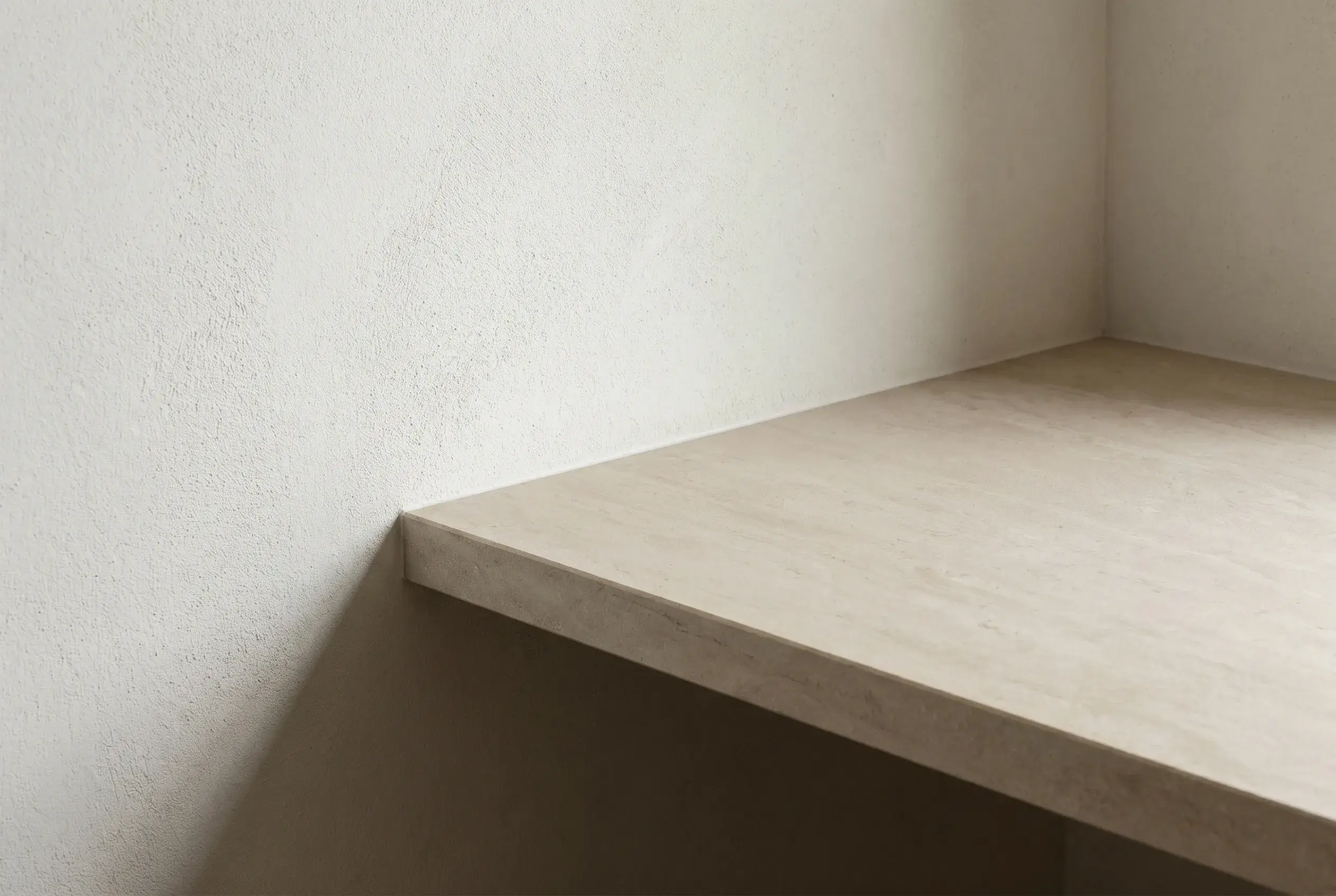
Every house we draw has a corner that we treat as carefully as the bigger gestures. It is usually a shelf set into the plaster, a quiet rectangle two or three hundred millimetres deep, in stone or oak, lit by whatever happens to be passing through the room that day.
The point is not really the shelf. The point is the discipline of saying that this corner deserves a thing in it, and that the thing should be drawn at full size before it is built.
Most clients ask for storage. We are usually drawing for something slower than that. The niche is not where you put the post; it is where you set down a book that you have not yet finished, a candle, a small piece of work the kids brought home from school, a glass of water that you mean to drink before bed.
“A house is the sum of its small surfaces. Get those right and the bigger rooms tend to look after themselves.”
The detail matters. Three millimetres of shadow gap between the shelf and the wall reads as something held by light rather than glued to plaster. The front edge is bevelled the same way every shelf on the project is bevelled, so the house feels drawn by one hand. The bracket underneath is invisible.
None of this is clever. All of it is the kind of work that asks for a Wednesday afternoon and a 1:1 drawing, and a willingness on the client’s part to spend ten minutes on a corner that most people will never notice. The people who live there will, though — every day, for the rest of the house’s life.