
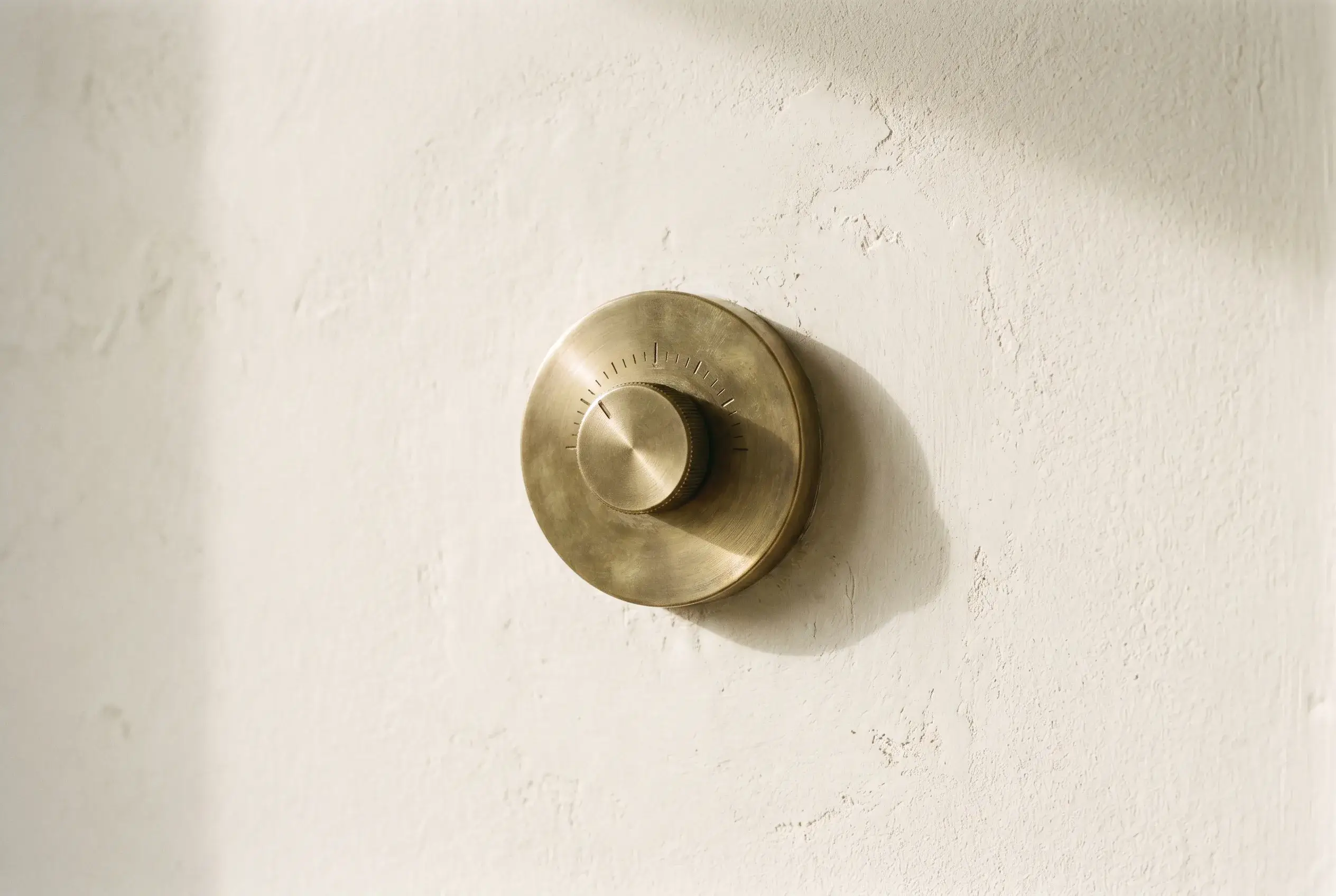
A house should be possible to turn on with one hand. The lighting in our projects is wired so that every room has a single dial near the door, you walk in, you turn it, and the room comes up to the level you want it.
This is a small political position. The default in high-end residential is a Lutron or Crestron system, an app on a wall-mounted tablet, sixteen scenes per room. We have lived in houses with those systems. They are difficult to use, and they age badly, and the tablet stops working two years after the warranty.
The dial is brass, machined, ten millimetres proud of the plaster. It dims one circuit, slowly, from off to full. Behind it is a single LED driver tuned to the room. There is no scene called “evening”. The dimmer is the scene.
“If the architecture is right, you don’t need sixteen lighting scenes. You need one fitting, well placed, and a way to take it up and down.”
This means the lighting design happens earlier. You can’t paper over a badly-placed downlight with a programme. The fitting has to be where the wall meets the ceiling, or held off the ceiling, or hidden behind a coffer, before the cable is run. The plan and the section have to know about it.
What you get in return is a house that you can hand to a teenager without an instruction manual. They walk in. They turn the dial. The room comes up.